The Internet Is Being Redesigned Around You. Without You.
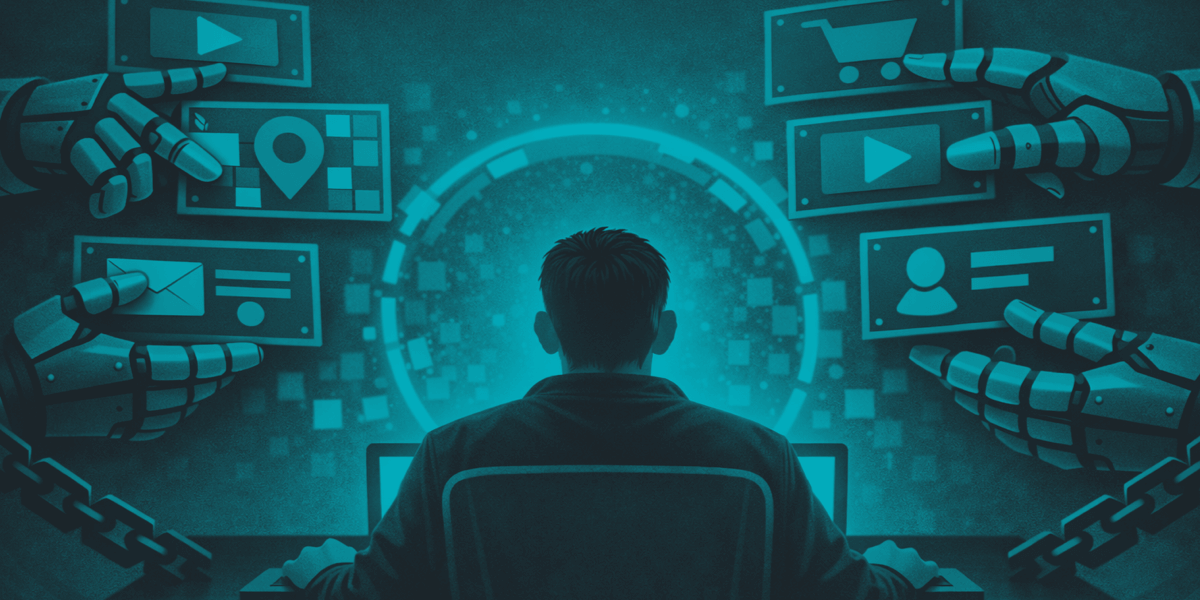
The internet is being redesigned around you. For you. And you don’t have a say in it.
A.I. is (not so) quietly rewriting the internet. Not by making it smarter.
But as Brian X. Chen wrote, by making it different for each of us.
Google drops Gemini into Gmail. Meta bakes an assistant into search. AI Overviews sit on top of results. And in most cases, you don’t get a real choice. No clear “off.” No meaningful consent.
That is not innovation. That is control disguised as convenience.
And the truth is, it’s easy. It’s a lifesaver. It feels like magic because it removes friction you’ve learned to live with. And once you get a taste of that kind of convenience, it’s almost impossible to go back. But something deeper is going on.
Because when a tool becomes the interface to your life, it doesn’t just help you do things. It starts deciding what you see, what you trust, and what you do next. The screen stops being a window and becomes a filter into and out of your world. And the filter is wholly owned by someone else.
That’s a really big deal. Don’t let anyone tell you otherwise.
Here’s what’s actually happening: the web is shifting from an open marketplace of information into a personalized, private corridor of persuasion. Your questions, your hesitations, your late-night anxieties, your shopping intent. All of it becomes a signal.
And the business model is obvious.
AI is expensive. Subscriptions alone won’t pay for it.
So the next era is going to be funded by the oldest engine on the internet: advertising.
Except this time, ads won’t just target demographics. They’ll target you. Not the you you post online. The “you” you confess to a machine at 1 a.m.
Your tone. Your budget. Your vulnerabilities. Your dreams.
Your spouse’s birthday. Your shame. Your fear of missing out. Your grief. Your health.
They won’t just learn what you like. They’ll learn what moves you.
And once a system can model your intent in real time, it doesn’t wait for you to search. It anticipates. It suggests. It steers.
The pitch becomes invisible. The choice feels like yours.
And that’s exactly the point. And the scariest part isn’t the personalization.
It’s the asymmetry.
The system knows you. You don’t know the system.
It won’t just learn what you like. It will learn what moves you.
Your patterns. Your pressure points. Your private logic.
And once it has that, it doesn’t need your attention. It has your leverage.
And when every person is being optimized separately, there is no longer one internet.
There are billions of them all being nudged in slightly different directions. And you don’t get to see the version everyone else is living in. That’s how the internet stops being shared space and becomes individualized control.
If we’re building an internet where every person lives in a different version of reality, then user agency is not a “nice-to-have.” it’s the product controlled by the forces that own the interface between you and the world. And when a tool becomes your only interface, it becomes a gatekeeper, too.
The future of AI won’t be decided by who can summarize your email the fastest.
It will be shaped by who you decide gets to shape your reality, one “helpful” suggestion at a time, and whether you still have the right to choose.
Because if you can’t turn it off, it isn’t a feature.
It’s a takeover.
And in the end, the question is simple:
Do you own the tool
Or does the tool own you?
No. Not like this.
So here’s the call to action.
We don’t need more AI everywhere.
We need AI you can see, govern, and evolve. Safely, with your understanding, your permission, and your consent.
That is what we’re building at aiXplain.
Not a black box that follows you around the internet.
A system with all the dizzying wonder of the best of our technological golden age, but a system that you own.
A system that combines breathtaking evolution and innovation with identity, permissions, audit trails, and real controls.
A system that works with you. A system built for teams who take responsibility seriously.
If AI is going to be the new interface, then it has to come with a new standard for every machine that every human can live with: autonomy by design.
We live in one of the most innovative times our species has ever been through. But it’s time to stop accepting AI as something that just happens to people. It’s time to start building AI that works for them.
The views expressed in this article are solely those of the author and do not necessarily reflect the views of their employer or affiliated organizations. We have cookies!