Beyond Workflow Builders: aiXplain’s Vision for the Post-AgentKit Era

Why the Future of AI Systems Lies Beyond Visual Workflow Builders and Static Agents
The release of OpenAI’s AgentKit marks an inflection point in the evolution of intelligent systems. For the first time, developers can build, deploy, and evaluate agents within a unified stack that combines a visual canvas, guardrails, connectors, and integrated evaluations. This innovation accelerates the mainstream adoption of agentic systems — yet, as the complexity of enterprise AI tasks grows, it also exposes the limits of visual workflow-centric design. The same bottlenecks that plagued low-code automation tools are re-emerging in agentic AI development: rigidity, brittleness, and poor scalability under long-running, branching workflows.
At aiXplain, we believe the next paradigm requires frameworks that are not another workflow builder, but a true orchestration and evolution substrate for intelligent, adaptive, multi-agent systems. Our Agentic Framework embodies that shift — combining automatic planning, execution, evaluation, and self-optimization into a single architecture capable of powering deep-research agents, RFP streamliners, BI analysts, and autonomous enterprise copilots.
The Problem: Agent Workflows Are Growing Exponentially in Complexity
In modern enterprises, agent tasks are no longer short prompt-response loops. They are long-horizon processes spanning hours or days — orchestrating sub-agents for research, analysis, summarization, and synthesis. Our internal metrics show that agent task duration and complexity double every 3–7 months, outpacing the capacity of current frameworks to model them.
Frameworks like LangGraph and CrewAI expose low-level graph semantics for chaining agents. While powerful, they demand expert engineering to build branching workflows that handle dependencies, loops, and aggregation — often taking days to weeks per use case.
At the other extreme, visual workflow builders such as AgentKit, n8n, and Flowise offer easy entry but collapse under graph complexity, becoming unreadable and unmaintainable as workflows scale. The result: enterprises must choose between expressivity and usability. Neither side scales well for real-world, long-running agents.
The AgentKit Moment
In October 2025, OpenAI’s AgentKit introduced the most polished attempt yet to reconcile this tension. It delivers a unified agent development stack, including:
- Agent Builder: A visual environment for composing multi-step, branching agents
- Connector Registry: Centralized control of data and tool access
- ChatKit: Easy embedding of agent interfaces into applications
- Integrated Evals: Built-in prompt optimization, trace grading, and reinforcement tuning
- Agents SDK: Python/Node SDK sharing the same runtime for code-first development
In essence, AgentKit merges no-code design, guardrail management, and evaluation into a coherent platform — effectively becoming the “Agentic Zapier” for developers and enterprises alike. Yet, while AgentKit makes the workflow-to-agent transition approachable, it remains bounded by the static workflow paradigm at its core.
Where AgentKit Reaches Its Limits
AgentKit’s integrated stack solves many pain points of current frameworks, but it stops short of enabling autonomous, evolving, long-running agents. Its architecture, grounded in visual node graphs and human-defined plans, inherits several key limitations:
- Static graph semantics: Visual nodes can represent conditional branching and tool calls, but cannot dynamically reconfigure based on agent outcomes or self-evaluation.
- Limited planning autonomy: AgentKit assumes a human defines the structure; it cannot yet generate or optimize agent workflows autonomously.
- No workflow evolution: Prompt optimization exists, but architectural evolution — the ability to mutate and select improved workflows — does not.
- Short-horizon focus: It targets task-bounded sessions, not persistent, stateful orchestration over days or weeks.
- Scaling bottlenecks: Visual graphs lose clarity as nodes scale into the hundreds; enterprises require modular nesting and automatic pruning.
These constraints make AgentKit a powerful on-ramp — but not the destination. The next step is a framework that plans, executes, evaluates, and evolves itself.
aiXplain’s Agentic Framework and Builder — Beyond AgentKit
aiXplain’s Agentic Framework was engineered precisely to transcend these boundaries. It unites planning, orchestration, evaluation, and evolution in a cohesive substrate for enterprise AI agents.
Our design philosophy resonates with the LangChain argument in “Not Another Workflow Builder”: the future of agent development isn’t about more visual nodes, but better abstractions for reasoning, evaluation, and tool orchestration. aiXplain succeeds in productizing that vision.
The new orchestrator: Executing dynamic computational graphs
- Supports branching, looping, and aggregation with explicit dependency management.
- Enables long-running, stateful workflows with persistent context and checkpointing.
- Powers deep-research agents capable of autonomously authoring and refining book-length outputs.
Bel Esprit and Mentalist: Intelligent workflow planners
- Bel Esprit collaborates with humans to co-plan multi-agent workflows; Mentalist plans them autonomously.
- Both can auto-create sub-agents and guardrails, dynamically adjusting architecture to task feedback.
- Bel Esprit acts as a Cursor-like IDE for agent design — users describe what they want; it engineers a sophisticated, loop-aware, predicate-gated workflow in minutes.
Unlike the assistants in other frameworks, Bel Esprit doesn’t merely suggest — it builds, tests, and refines agents in real time.
Inspector and Evolver: Trust and continuous improvement
- Inspector micro agent guarantees execution fidelity, compliance, and reproducibility through auto-evaluation and monitoring against user-defined guardrails.
- Evolver meta agent benchmarks agents, analyzes failures, and proposes graph refinements — continuously improving workflows, not just fine-tuning prompts.
Together they enable continuous agent development through conversation: users describe needs “Build me an RFP writer integrating legal, pricing, and technical feedback”, and within a session receive a production-ready, auditable, evolvable, compliant agent.
This compresses the entire lifecycle — planning, building, testing, debugging, optimizing — from months into days. Where AgentKit’s strength ends with static DAGs, aiXplain begins: delivering adaptive, feedback-driven systems that evolve themselves.
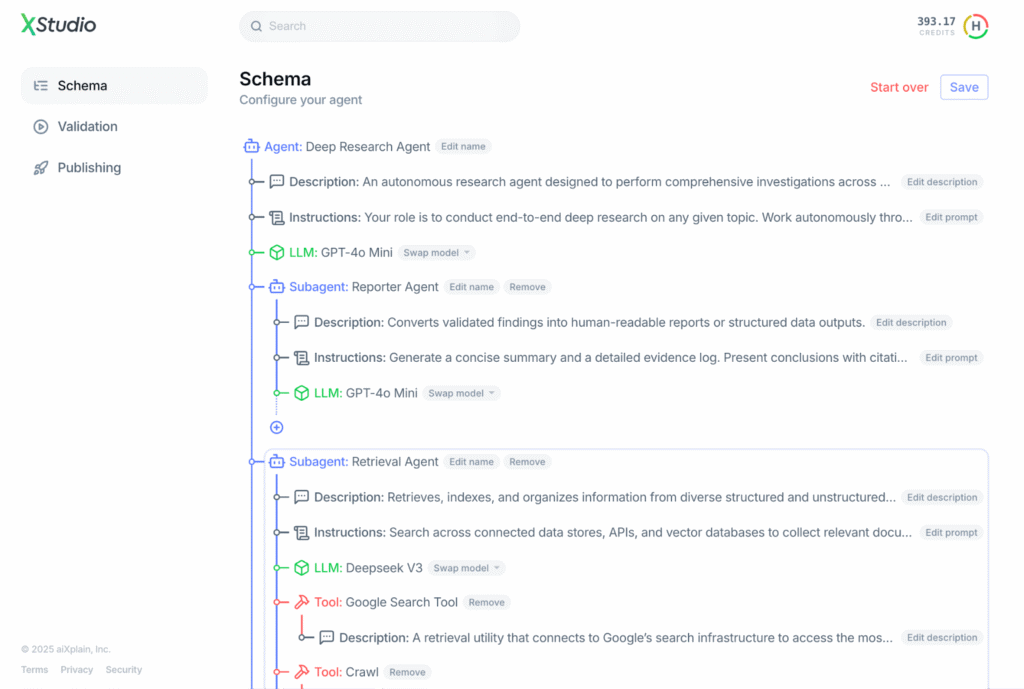
aiXplain’s Agent Builder reflects the modular architecture and autonomous behavior of aiXplain agents.
Unlike workflow builders that depend on manual wiring, fixed routes, and node sprawl, the Agent Builder abstracts away flow design entirely. Each agent module knows its purpose and autonomously invokes the right tools and sub-agents at runtime — no drag-and-drop complexity, no brittle logic to maintain.
From a usability perspective, this shift is transformative. Users describe intent instead of constructing flows. Agents self-organize into dynamic, reusable components that can evolve, scale, and adapt without redrawing a single connection. The result is a cleaner, more natural development experience — one focused on outcomes, not wiring diagrams.
Why aiXplain is a Decacorn in the Making
The billion-dollar valuation of n8n underscores how much enterprises value tools that lower the barrier to workflow automation. But n8n’s ceiling is clear: its static DAGs can’t build themselves, adapt, or evolve. aiXplain’s Agentic Framework is to n8n what Cursor is to Zapier — it reinvents the environment around AI development itself. Bel Esprit provides conversational, AI-assisted engineering of agents; Inspector ensures trust and compliance; Evolver delivers self-improvement at scale.
If static builders can reach unicorn status, a framework that enables auto-evaluated, self-improving, enterprise-grade Agentic AI development defines the decacorn category. aiXplain isn’t the next n8n — it’s the next Cursor, but for agents: compressing weeks into days and transforming how enterprises build, trust, and continuously improve production-grade AI systems.
This article was co-authored by Kamer Ali Yuksel and Nur Hamdan of aiXplain.
 We have cookies!